
How to Connect an AI Support Assistant to Order and Customer Data

A customer asks about an order, and your support team opens several systems to understand the situation. Adding an AI assistant introduces another participant in that workflow. Its usefulness depends on how it connects to the information your business already uses. Planning those business-system integrations starts with the support task, the data behind it and the people responsible for the answer. At Burst Online, we frame that work around existing systems and our delivery approach before choosing a build.
Define the Support Task Before the Connection

Begin with a specific customer question and the work your team performs to answer it. An assistant intended to help with order enquiries needs a different brief from one that routes general questions. Write down the problem you want to improve so the integration has a clear purpose.
At Burst Online, our planning starts with goals, systems, constraints and the data involved. That discovery step gives the project a practical boundary. It also helps separate the customer-facing conversation from the operational work happening behind it.
Keep the first brief focused. Useful planning questions include the following:
- Which support task should the assistant help with?
- Which existing system holds the information needed?
- Who reviews an answer or takes over the conversation?
Map the Systems Behind Orders and Customers

Customer and order information may sit across a storefront, CRM, ERP and operational systems. Map the systems your business actually uses before discussing a connection. The aim is to understand how the information moves today and which dependencies the project must account for.
Our integration work covers commerce platforms, back-office systems, warehouses and data layers. The same planning discipline applies to an assistant: identify the information it needs and the existing process that produces it. A broad instruction to connect everything leaves too much undefined.
Bring the people who maintain those systems into the discussion. They can explain the current workflow and the constraints that a new connection must respect. That gives the project a firmer starting point than assuming every piece of customer information comes from one place.
Scope the Integration With the Development Team
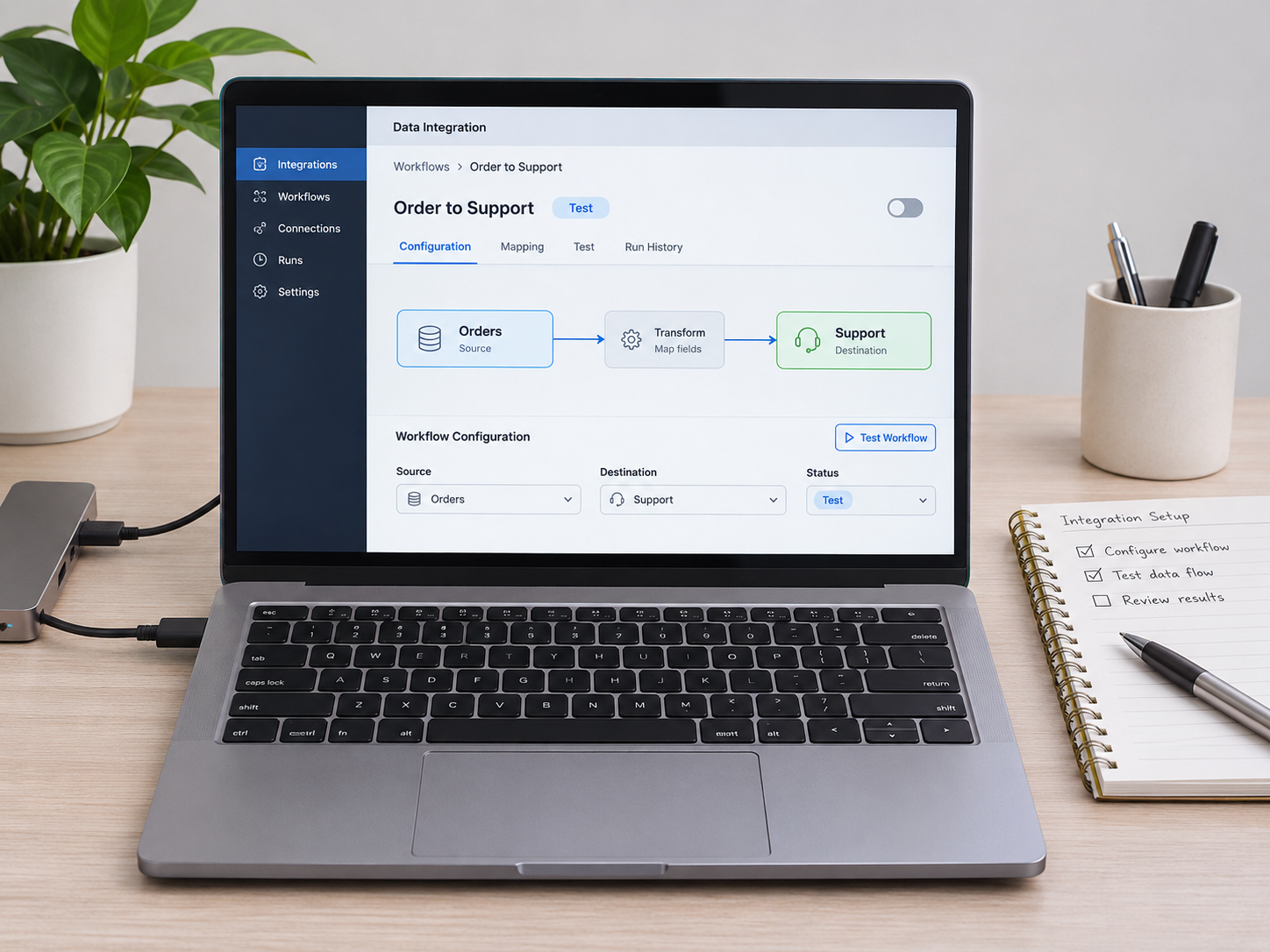
Once the support task and systems are clear, define the integration work. Our services include REST and webhook integrations, database support and custom backend development. Which of those services fits the project depends on the systems involved and what the assistant needs to do.
Describe the required information and the intended workflow before selecting a technical route. The website outlines integration capabilities, rather than a universal connector or a step-by-step implementation for every order platform. A project-specific technical review is therefore part of the work.
Keep the scope concrete enough to discuss. Record the relevant systems, the planned information flow and any operational constraints. That brief helps the team identify dependencies and agree on a realistic first phase without assuming an off-the-shelf connection will cover the whole requirement.
Keep Human Review in the Workflow

An AI assistant still needs a place within the support team's work. Decide where a person reviews the information, handles a question outside the initial scope or continues the conversation. Human-in-the-loop review is one of the capabilities we include in our AI workflow services.
Discuss those review points alongside the data connections. A working integration and a useful support process are separate things to evaluate. The project brief should make clear how the assistant and the people supporting it work together.
Include security posture and ongoing maintenance in the planning conversation as well. Our audit considers the systems behind the website together, including automation gaps. It gives the team a way to discuss those dependencies before introducing a new assistant into daily operations.
Launch in Phases and Review the Results

Move from discovery to an agreed roadmap, then build, integrate and test in phases. This follows our delivery approach: understand the systems first, define the work, carry out QA and launch planning, and continue reviewing the result after launch.
Agree on what the first phase should demonstrate. The initial support task provides the reference point for that review. Keep the measures connected to the business goal rather than treating the presence of an assistant as the result in itself.
Use what the first phase reveals to guide subsequent work. Our ongoing services include reporting, maintenance and optimization, so the connection remains part of a supported system. Expanding the scope should follow that review instead of adding more workflows simply because more integrations are possible.
Frequently Asked Questions
Can Burst Online Connect AI Assistants to Business Data?
Our services include AI assistants tied to business data, REST and webhook integrations, database support and custom development. The scope depends on the systems and workflow involved.
Do I Need to Identify Every System Before Starting?
Bring the systems you know about and the support problem you want to address. Discovery can map dependencies and clarify the information flow before the build is defined.
Does the Website Provide a Ready-Made Connector for Every Platform?
The website describes integration services, not a universal connector. A technical review is needed to establish the appropriate work for the business.
Final Takeaway
Connecting an AI support assistant to order and customer data begins with a clear support task and a realistic picture of the systems behind it. Define the information flow, agree on the integration scope and keep human review within the process. A phased launch then gives the team something specific to test and improve. At Burst Online, we bring those planning, development and operational considerations into the same conversation. The goal is a supported connection that fits the way the business works, with further changes guided by what the initial phase actually demonstrates.
Note: This article provides general information about digital marketing, websites and AI-enabled services. Recommendations and outcomes depend on your goals, audience, data and systems. Visit Burst Online to discuss guidance suited to your business.

Member discussion